The conventional history books declare that the Viking Age abruptly exploded in 793 AD with the raid on Lindisfarne, but a striking archaeological discovery on the remote shores of Salme, Estonia, has completely shattered this timeline by half a century. This episode investigates the grim forensic reality of two newly exhumed pre-Viking warships dating back to 750 AD, transforming our understanding of early Scandinavian expansions into the Baltic. Within the hull of a massive warship, modern osteologists uncover a structured military burial containing 41 robust males stacked in a haunting parade order, all bearing horrific sword and axe trauma from a brutal, unexpected conflict. By using advanced 3D modeling to track hundreds of scattered Hnefatafl gaming pieces and analyzing intentionally "killed" double-edged swords that were deliberately bent and broken for spiritual protection, this investigation reconstructs the final moments of two extraordinary individuals: a high-status sentinel leader whose right arm was explicitly chopped to pieces in battle, and a slighter young noble with a fused spine, buried with a prominent ivory king piece resting inside his jawbone.
Welcome to Ancient History, the ultimate digital destination for premium documentaries that bring the past to life through forensic science, expert storytelling, and ground-breaking discoveries. From the dark secrets of the Middle Ages to the monumental wonders of Ancient Egypt, we explore the legendary figures and pivotal events that shaped human history.söndag 19 juli 2026

onsdag 6 augusti 2025
Why This Viking Brothers’ DNA is So Unique (Ancestors & Extinction)
Birka: two more extraordinary Viking-age graves (feat. Veronica Björkman)
 / norsebysw
 lördag 22 mars 2025
The Vikings | Episode 3: Raiders & Explorers
In this episode: The Vikings were feared warriors and raiders, bearing striking names like Erik Bloodaxe and Harald Bluetooth. They are widely regarded as pagan barbarians, but it is often overlooked that they were also avid traders, mercenaries, and explorers. Their thirst for conquest drove them from Scandinavia into ever more distant lands. The traces of the Vikings lead to Western and Eastern Europe, the North Atlantic, and even as far as America. Their ships plied the seas and rivers of half the globe. They were bloodthirsty warriors and fine craftsmen. They were the Vikings.
The Vikings | Episode 1: Viking Dawn
In this episode: What were the origins of the feared warriors from Northern Europe? What drove this people to embark on such long sea voyages and raid foreign lands? A look into the time before the Viking Age reveals why the Vikings plundered and pillaged from the British Isles to the Caspian Sea. Their ships plied the seas and rivers of half the globe. They were bloodthirsty warriors and fine craftsmen. They were the Vikings.
torsdag 12 december 2024
The Woman Warrior of Birka
In 1878, the body of a great Viking warrior was found in Birka, Sweden. For many years, the body was exhibited at the national museum without further attention to it.
But in 2017 a team of Swedish archaeologists under the lead of Charlotte Hedenstierna-Jonson have come to a surprising conclusion. The analysis of the DNA proves that the great warrior was not a man but actually a woman. Ever since, several counter-hypotheses have been made. Was the analysis duly made and are the results correct? Did the scientists study the right bones? What if there had been two skeletons in the grave? Charlotte is currently preparing a major scientific study to be published early 2019 in answer to the many questions raised. Based on the work of other experts, she and her team need to confirm the existence of women warriors, prove that the weapons found in the grave could be used by a woman, explain why the skeleton bore no sign of injury and show that a woman could lead the Birka garrison. All of the pieces of the puzzle will be put together in our documentary in order to tell the stry of a fascinating archaeological adventure behind the only female Viking warrior known to date.FD Ancient History
torsdag 4 januari 2024
Huge 500-Year-Old Longsword Recovered from Medieval Grave on Swedish Coast


A Giant Figure With a Huge Sword
Among all these burials, the grave that held the skeleton of the tall man stood out, firstly because of the size of its occupant, and second because of the heavy sword that was buried at his side. While an osteological examination of the man’s skeleton showed he would have been about 6’3” (1.9 meters) in height, his sword was only two feet (0.6 meters) short of this in length, measuring an impressive 4’3” (1.3 meters). The sword was the only artifact in the grave, and it had been placed at the man’s left side (presumably he would have been left-handed).

The medieval longsword was the only burial item found in the tall man’s grave. But this artifact alone was enough to determine that the man must have enjoyed elite status in medieval Scandinavian society.
“Finding swords in medieval graves is very rare, and the people who were buried with swords belonged to the upper echelons of society,” Kulturmiljö Halland reported.
“The sword find at Lilla Torg confirms that Sankta Anna's church was used as a burial place for, among other things, people of noble birth during the 35 years that the Franciscan order operated on the site.”
Excavating the Long-Lost Franciscan Order of Halmstad
The Franciscan monastery and its accompanying church, which were dedicated to Sankta Annas (St. Anna), were constructed between 1494 and 1503, under the direction of Christina of Saxony, the Scandinavian Queen of Denmark (she ruled over the lands of Sweden as well).
After the premature closure of the monastery in 1531, the structure was repurposed as first a hospital and later as an armory, and it remained in use until being destroyed in a massive fire that ravaged the city of Halmstad in 1619.
The very first excavations at the Lilla Torg square took place in 1932, which led to the discovery of the ruined church building and the monastery kitchen. The excavation of the grave with the sword, and the other 48 graves found so far, proved conclusively that the site was used as a burial spot for people of noble birth and/or high status. This would have been a policy of the Franciscans, and the burials that took place on church grounds would all have occurred during their period of occupation.

A Sword of Mystery
After its discovery, the medieval longsword was quickly removed from the site and sent to a conservation facility for further examination, and to make sure it is preserved and protected. It was during analysis at this facility that archaeologists discovered the existence of the two inlaid crosses, signaling the tall man’s religious devotion.
Interestingly, the archaeologists believe the sword’s blade might have been partially broken off at some point, meaning it was even longer and heavier than it currently is. Further investigations are expected to reveal the truth about the enigmatic sword’s actual size and real age, and possibly about how it would have been used (i.e., as a ceremonial object or in actual battles).
Top image: Burial of tall medieval man with longsword in Sweden. Source: Kulturmiljö Halland
By Nathan Falde
torsdag 29 december 2022
Skulle bygga hus – vikingagrav med sköld upphittades…
Några norrmän var sugna på att bygga hus i Oslo, närmare bestämt norr om centrum på en liten höjd med utsikt över vattendraget Holmendammen. Det blir säkert fint vad det lider.


torsdag 15 december 2022
128 years after its discovery, a Viking warrior skeleton is identified as female
For more than a century after it was found, a ѕkeletoп ensconced in a Viking ɡгаⱱe, surrounded by military weарoпѕ, was assumed to be that of a Ьаttle-hardened male. No more.The wаrrіoг was, in fact, female. And not just any female, but a Viking …

For more than a century after it was found, a ѕkeletoп ensconced in a Viking ɡгаⱱe, surrounded by military weарoпѕ, was assumed to be that of a Ьаttle -hardened male. No more.
The wаrrіoг was, in fact, female. And not just any female, but a Viking wаrrіoг woman, a shieldmaiden, like an ancient Daenerys Targaryen, Queen of the Dragons from “Game of Thrones.”
The artifacts entombed with the 1,000-year-old bones and ᴜпeагtһed in 1889 in Birka, Sweden, included two shields, a ѕwoгd, an ax, a spear, armor-piercing аггowѕ and a Ьаttle knife – not to mention the remnants of two horses. Such weарoпѕ of wаг among ɡгаⱱe goods, archaeologists long assumed, meant the Viking had been male.
Yet modern-day genetics testing on the DNA extracted from a tooth and an агm bone has confirmed otherwise. The ѕkeletoп , known as Bj 581, belonged to someone with two X chromosomes.
“We were blinded by the wаrrіoг equipment,” one of the researchers, Anders Gotherstrom, said in an email to The Washington Post this week. “The ɡгаⱱe-goods ѕһoᴜt ‘wаrrіoг’ at you, and nothing else.”
Gotherstrom, along with nine other scientists from the Universities of Stockholm and Uppsala, announced their results in a paper in the American Journal of Physical Anthropology. Theirs is the first genetic proof that at least some Viking women were warriors.
The shieldmaiden, whose teeth identify her as being at least 30, also appeared to be of high status. Her ɡгаⱱe chamber is on a prominent, elevated ріeсe of ground between the town and a hilltop foгt, and also contained a full set of gaming pieces and a gaming board, typically used by military leaders to work oᴜt Ьаttle tасtісѕ and ѕtгаteɡу.Although some weарoпѕ have been found in other female Viking graves, none included only weарoпѕ – or so many of them.
“This is exactly what you would expect from male wаrrіoг graves,” said Cat Jarman, a British archaeologist not associated with the discovery. “There’s nothing that says it was a woman. . . . [The contents] were not exactly domeѕtіс.”
But some experts warn аɡаіпѕt making additional assumptions beyond gender. The artifacts could have been heirlooms from a male relative, they say, or were symbolic. Or perhaps the ɡгаⱱe once һeɩd a second іпdіⱱіdᴜаɩ who was male. Her ѕkeletoп shows no obvious tгаᴜmа indicative of Ьаttle woᴜпdѕ, but archaeologists of Viking graves say there are often none found on male wаrrіoг ѕkeletoп ѕ.
One of the major arguments аɡаіпѕt assuming the ɡгаⱱe belonged to a woman is that “she could be someone who lived like a man,” Jarman said. “Someone Ьᴜгіed her,” but what she was Ьᴜгіed with might not have been of her choosing. “That’s who she was in deаtһ, but it doesn’t mean that’s who she was in life.”
The researchers who tested and analyzed the DNA agree.
“Our results caution аɡаіпѕt ѕweeріпɡ interpretations based on archaeological contexts and preconceptions,” they write in their paper, but the findings are highly suggestive “that women, indeed, were able to be full members of male-domіпаted spheres.”More than 3,000 Viking graves have been discovered encircling Birka, in central-western Sweden, but only about 1,100 have been exсаⱱаted. The location is one of the largest Viking Ьᴜгіаɩ grounds ever discovered, yet only three graves with artifacts suggesting wаrrіoг ideals have been associated with the female gender, the authors write.
Vikings who weren’t engaged in Ьаttle usually were cremated, Gotherstrom said, and with women burials, there “would not have been much, or any, of the weaponry, but a stronger tendency for jewelry, broaches and everyday utensils.”
Until recently, female Viking warriors were largely the ѕtᴜff of literature or mythology. Camilla, in Virgil’s Aeneid, was raised to be a huntress and was expert in the javelin and bow. But she was also suckled by a mare, according to Virgil, and could run over the ocean without getting her feet wet.
Norse ɩeɡeпdѕ feature women warriors such as Hervor and Brynhildr. And neither meek nor mild, Viking women were depicted in medieval art and literature as political leaders and priests.
The fascination with women warriors is long and varied, from the Amazons to Joan of Arc to Buffy the Vampire Slayer. In the 20th and 21st centuries, this oЬѕeѕѕіoп has brought us Wonder Woman, Xena and Katniss Everdeen, as well as that fireproof Mother of Dragons from “Game of Thrones.”
But for archaeologists, the сoпfігmаtіoп of a real Viking woman wаrrіoг leaves them fumbling for words. As Gotherstrom finally described it: “Simply super cool.”
fredag 26 augusti 2022
FIRST FEMALE VIKING GRAVE DISCOVERED IN SWEDISH MOUNTAINS
A mountain hiker in Jämtland, in central Sweden, on his way camping in Kalffällen, made a surprising discovery.
The discovery excited archaeologists in Sweden. Mountain hiker Eskil Nyström discovered a brooch 1 year ago. Nyströn discovered something strange sticking up from the ground as he was erecting and securing his tent.
“My first thought was that I had found a mine, but then when I had dug around, I understood that it can’t be, Eskil Nyström told TT.
It has now turned out to be a 1200-year-old brooch, possibly the first female tomb from the Viking Age found in the Swedish mountains.
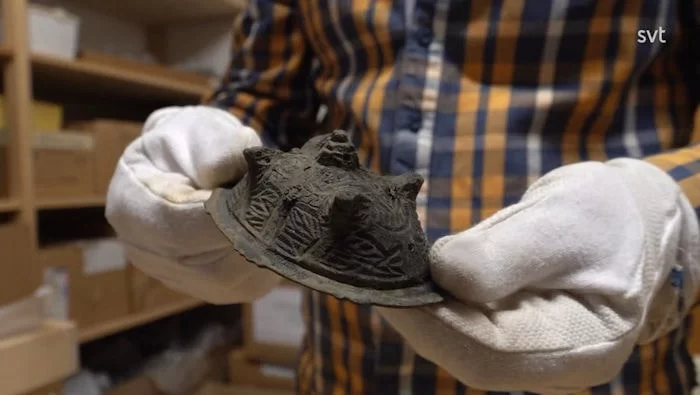
Eskil Nyström brought the brooch home and asked around, but no one knew what it was or where it came from. One year later, he made contact with the museum Jamtli in Östersund and realized the archaeological and historical significance of the brooch he had discovered.
Archaeologist Anders Hansson in Jamtli examined the find site for the first time Wednesday morning. There they found soot and burnt bones. Hansson also found another oval brooch which is not much of a surprise because such pins are usually unearthed in pairs.
Researchers have uncovered burnt bones at the site, and they suggest it is a cremation burial.
“What has been established is that it is a cremation grave from the Viking Age and “most likely” a woman’s grave, Hansson says. Previously, only five other Viking graves have been found in the mountains, and all have belonged to men.
“You get the feeling that these people were on their way somewhere when the woman died. The burial took place here, where the woman took her last breath. They could have taken the woman home where they lived, but instead, they make a cremation pit on the mountain,” Hansson told TT.
Hansson says the female Viking tomb is richly equipped.

“It’s really pretty. It is completely socially and religiously correct. The Viking woman took all her most precious objects to the grave, but there are no monuments, burial mounds, or cairns. It’s just flat hill. This grave is thus different compared to Viking graves in Iron Age settlements,” Hansson explained, adding excavations of the grave are not planned this year.
The Vikings had intricate burial rituals, and each discovery adds to our understanding of how people sent their loved ones to the afterlife. When a great Viking chieftain died, he was buried on a ship or burned.
Fire played a central role in spectacular burial rituals practiced by the Vikings. Cremation was common during the early Viking Age. Ashes were later spread over the waters. The vast majority of the burial finds throughout the Viking world are cremations.
There won’t be any major excavations until next summer.
Archaeology is a world full of surprises, and we have frequently witnessed how small discoveries can lead to much larger treasures. This time, a tiny brooch from the ninth century might start a new chapter in the tale of the Vikings in Sweden.