The conventional history books declare that the Viking Age abruptly exploded in 793 AD with the raid on Lindisfarne, but a striking archaeological discovery on the remote shores of Salme, Estonia, has completely shattered this timeline by half a century. This episode investigates the grim forensic reality of two newly exhumed pre-Viking warships dating back to 750 AD, transforming our understanding of early Scandinavian expansions into the Baltic. Within the hull of a massive warship, modern osteologists uncover a structured military burial containing 41 robust males stacked in a haunting parade order, all bearing horrific sword and axe trauma from a brutal, unexpected conflict. By using advanced 3D modeling to track hundreds of scattered Hnefatafl gaming pieces and analyzing intentionally "killed" double-edged swords that were deliberately bent and broken for spiritual protection, this investigation reconstructs the final moments of two extraordinary individuals: a high-status sentinel leader whose right arm was explicitly chopped to pieces in battle, and a slighter young noble with a fused spine, buried with a prominent ivory king piece resting inside his jawbone.
Welcome to Ancient History, the ultimate digital destination for premium documentaries that bring the past to life through forensic science, expert storytelling, and ground-breaking discoveries. From the dark secrets of the Middle Ages to the monumental wonders of Ancient Egypt, we explore the legendary figures and pivotal events that shaped human history.söndag 19 juli 2026

The Lost Viking Treasure Buried Beneath Europe
Vikings The Lost Realm
onsdag 6 augusti 2025
Why This Viking Brothers’ DNA is So Unique (Ancestors & Extinction)
Birka: two more extraordinary Viking-age graves (feat. Veronica Björkman)
 / norsebysw
 lördag 22 mars 2025
The Vikings | Episode 3: Raiders & Explorers
In this episode: The Vikings were feared warriors and raiders, bearing striking names like Erik Bloodaxe and Harald Bluetooth. They are widely regarded as pagan barbarians, but it is often overlooked that they were also avid traders, mercenaries, and explorers. Their thirst for conquest drove them from Scandinavia into ever more distant lands. The traces of the Vikings lead to Western and Eastern Europe, the North Atlantic, and even as far as America. Their ships plied the seas and rivers of half the globe. They were bloodthirsty warriors and fine craftsmen. They were the Vikings.
The Vikings | Episode 2: Viking Weapons
In this episode: The Vikings were feared warriors and are widely regarded as barbarians. However, they were also avid traders and explorers who acquired knowledge on their journeys and used it to develop their society further. This was reflected in the production of their weapons and equipment. In addition to their traditional shipbuilding, they crafted swords inspired by Continental Europe. Using their ships, the Vikings seized every opportunity to expand even more rapidly. Their ships plied the seas and rivers of half the globe. They were bloodthirsty warriors and fine craftsmen. They were the Vikings.
The Vikings | Episode 1: Viking Dawn
In this episode: What were the origins of the feared warriors from Northern Europe? What drove this people to embark on such long sea voyages and raid foreign lands? A look into the time before the Viking Age reveals why the Vikings plundered and pillaged from the British Isles to the Caspian Sea. Their ships plied the seas and rivers of half the globe. They were bloodthirsty warriors and fine craftsmen. They were the Vikings.
torsdag 12 december 2024
The Woman Warrior of Birka
In 1878, the body of a great Viking warrior was found in Birka, Sweden. For many years, the body was exhibited at the national museum without further attention to it.
But in 2017 a team of Swedish archaeologists under the lead of Charlotte Hedenstierna-Jonson have come to a surprising conclusion. The analysis of the DNA proves that the great warrior was not a man but actually a woman. Ever since, several counter-hypotheses have been made. Was the analysis duly made and are the results correct? Did the scientists study the right bones? What if there had been two skeletons in the grave? Charlotte is currently preparing a major scientific study to be published early 2019 in answer to the many questions raised. Based on the work of other experts, she and her team need to confirm the existence of women warriors, prove that the weapons found in the grave could be used by a woman, explain why the skeleton bore no sign of injury and show that a woman could lead the Birka garrison. All of the pieces of the puzzle will be put together in our documentary in order to tell the stry of a fascinating archaeological adventure behind the only female Viking warrior known to date.FD Ancient History
torsdag 13 juni 2024
Legendarisk vikingastad kan ha hittats i Polen
Den mytomspunna vikingastaden Jomsborg nämns i flera av de isländska sagorna och ska ha uppförts av Harald Blåtand på en ö i Östersjön omkring år 960. Trots flera hundra år av arkeologiskt arbete har det emellertid inte gått att hitta några bevis för stadens existens – förrän nu.
På den polska ön Wolin har arkeologen Wojciech Filipowiak funnit rester av bränt trä från 900-talet, som ser ut att ha varit delar av en försvarsanläggning.
Wojciech Filipowiak var egentligen inte på jakt efter vikingar. Han grävde i stranden på Wolin för att de lokala myndigheterna har planer på att bygga ett observationstorn på det som kallas Hangman Hill. Området användes i flera hundra år som avrättningsplats och begravningsplats. Det var denna mörka historia som Filipowiak skulle avtäcka.
Nu tror arkeologen att han i stället har löst ett av vikingatidens största mysterier.
Sagorna älskade jomsvikingarna
Wolin har i åratal betraktats som en av de troligaste placeringarna för Jomsborg. Ön var en del av Tyskland från 1871 till slutet på andra världskriget, och tyska arkeologer sökte under 1930-talet igenom ön på jakt efter den legendariska vikingastaden, men hittade inget.
Medan lokalstyret på Wolin ofta har framställt ön som den historiska hemvisten för Jomsborg, så har många historiker ansett att staden enbart skapats av sagornas författare.
Det finns många myter förknippade med de så kallade jomsvikingarna från ön. Jomsvikingarna ska ha varit ett förband av hårdföra och oerhört disciplinerade vikingar, som ska ha varit verksamma i Östersjön och Skandinavien på 900-talet.
Historierna om dessa fruktade vikingar och legosoldater blandar fritt historiska händelser med sagor. Jomsvikingen Palnatoke nämns till exempel ofta i sagorna och ska bland annat ha dödat Harald Blåtand genom att skjuta honom med en pil i rumpan, och som kom ut genom munnen.
Med det nya fyndet har Jomsborg förflyttat sig lite längre bort från sagorna och närmare verkligheten.
Vikingatidens New York
Enligt de gamla sagorna var Jomsborg vikingarnas maktcentrum i det baltiska området. Karolina Kokora, direktör för Wolins historiska museum, beskriver staden som ett ”medeltida New York i Östersjön”.
Det var ett myllrande handelscentrum med en heterogen befolkning bestående av vikingar, germaner och slaver. Staden hade en formidabel fästning och en lång pir, som kunde ta emot åtskilliga vikingaskepp.
Staden hade emellertid en utsatt position och belägrades och förstördes flera gånger. Först av den dansk-norske kungen Magnus den gode år 1043, och 1185 ska staden ha jämnats med marken av den danske biskopen Absalon. Efter det försvinner den befästa staden från de historiska källorna.
Det krävs givetvis ytterligare analyser och forskning för att kunna slå fast om det verkligen rör sig om den legendariska staden, men Wojciech Filipowiak anser att det redan är ”till 80 procent säkert” att det förhåller sig så.
”Debatten om Jomsborgs placering – eller om staden verkligen har existerat – har pågått länge. Förhoppningsvis kan jag bidra till att avsluta den”, säger Wojciech Filipowiak.
måndag 8 april 2024
Magnet fisherman finds Viking sword
First of all, there is such a thing as a magnet fisherman: ie, someone who uses a powerful neodymium magnet on a rope to retrieve metal objects from bodies of water. I did not know this. Secondly, magnet fisherman Trevor Penny pulled up an intact Viking sword from the River Cherwell in West Oxfordshire last November.
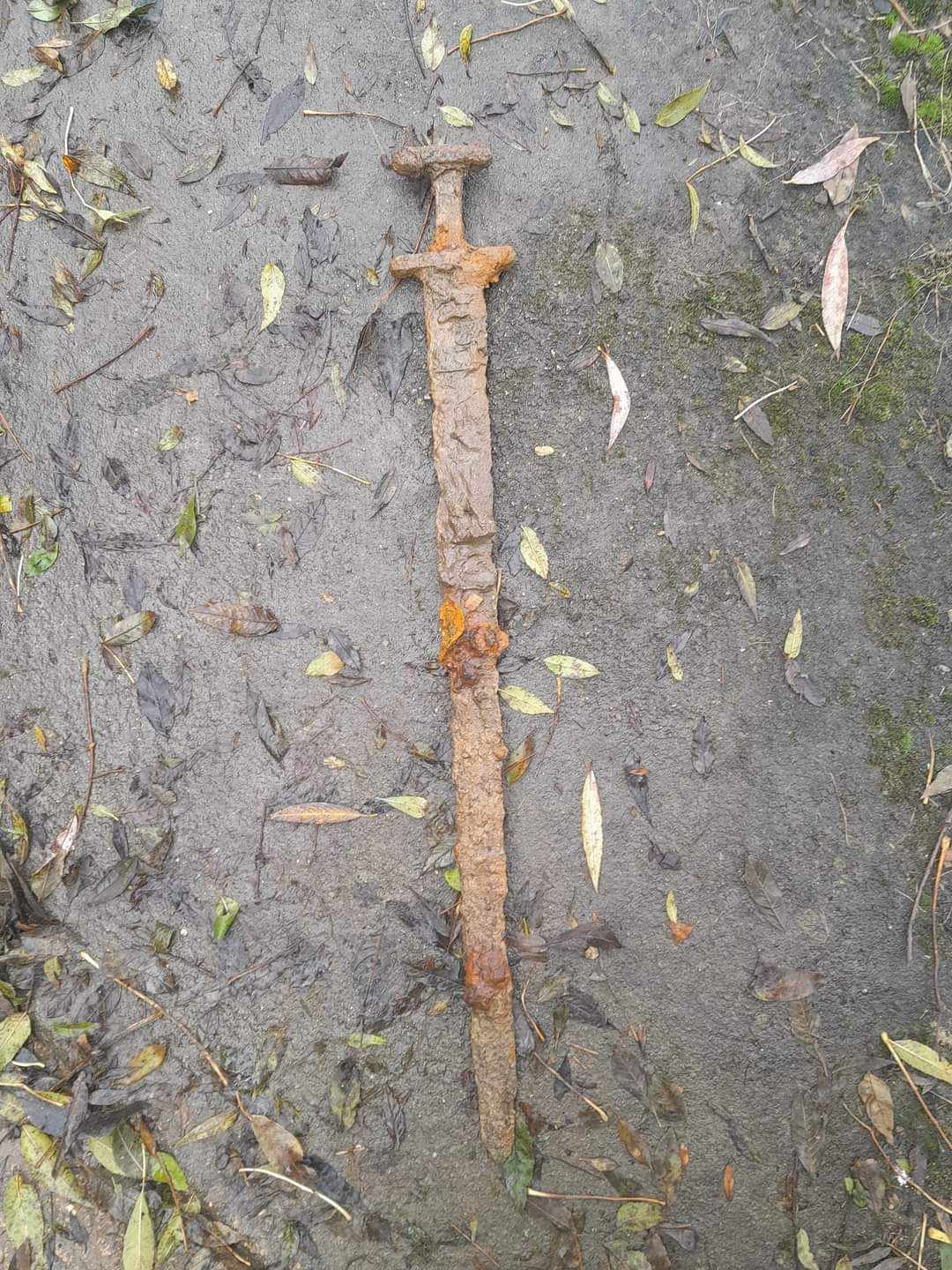

It looks like a Petersen Type M to my untutored eye, based on the hilt shaped like a capital I, the long blade and the date range. Type M swords in good condition can retain traces of organic remains (wood, leather, cloth) on the grip, so it’s important that this sword be carefully conserved. It is corroded, but there could be organic treasure hiding underneath that crusty exterior. Thankfully, the sword is already in the hands of museum professionals and will remain there.
Mr Penny confirmed that it will be retained by Oxford museum services and will either stay in Witney or be put on display in a museum.
He added: “There was a little dispute with the landowner and the rivers trust who don’t permit magnet fishing. The latter sent a legal document saying they wouldn’t take action on the condition the sword was passed to a museum, which I had done.”

torsdag 4 januari 2024
Huge 500-Year-Old Longsword Recovered from Medieval Grave on Swedish Coast


A Giant Figure With a Huge Sword
Among all these burials, the grave that held the skeleton of the tall man stood out, firstly because of the size of its occupant, and second because of the heavy sword that was buried at his side. While an osteological examination of the man’s skeleton showed he would have been about 6’3” (1.9 meters) in height, his sword was only two feet (0.6 meters) short of this in length, measuring an impressive 4’3” (1.3 meters). The sword was the only artifact in the grave, and it had been placed at the man’s left side (presumably he would have been left-handed).

The medieval longsword was the only burial item found in the tall man’s grave. But this artifact alone was enough to determine that the man must have enjoyed elite status in medieval Scandinavian society.
“Finding swords in medieval graves is very rare, and the people who were buried with swords belonged to the upper echelons of society,” Kulturmiljö Halland reported.
“The sword find at Lilla Torg confirms that Sankta Anna's church was used as a burial place for, among other things, people of noble birth during the 35 years that the Franciscan order operated on the site.”
Excavating the Long-Lost Franciscan Order of Halmstad
The Franciscan monastery and its accompanying church, which were dedicated to Sankta Annas (St. Anna), were constructed between 1494 and 1503, under the direction of Christina of Saxony, the Scandinavian Queen of Denmark (she ruled over the lands of Sweden as well).
After the premature closure of the monastery in 1531, the structure was repurposed as first a hospital and later as an armory, and it remained in use until being destroyed in a massive fire that ravaged the city of Halmstad in 1619.
The very first excavations at the Lilla Torg square took place in 1932, which led to the discovery of the ruined church building and the monastery kitchen. The excavation of the grave with the sword, and the other 48 graves found so far, proved conclusively that the site was used as a burial spot for people of noble birth and/or high status. This would have been a policy of the Franciscans, and the burials that took place on church grounds would all have occurred during their period of occupation.

A Sword of Mystery
After its discovery, the medieval longsword was quickly removed from the site and sent to a conservation facility for further examination, and to make sure it is preserved and protected. It was during analysis at this facility that archaeologists discovered the existence of the two inlaid crosses, signaling the tall man’s religious devotion.
Interestingly, the archaeologists believe the sword’s blade might have been partially broken off at some point, meaning it was even longer and heavier than it currently is. Further investigations are expected to reveal the truth about the enigmatic sword’s actual size and real age, and possibly about how it would have been used (i.e., as a ceremonial object or in actual battles).
Top image: Burial of tall medieval man with longsword in Sweden. Source: Kulturmiljö Halland
By Nathan Falde
söndag 19 november 2023
Jelling Stone: 3D scans reveal power of a Viking queen
måndag 1 maj 2023
Missat i 100 år: Georadar hittar 20 meter långt vikingaskepp
Den norske arkeologen Haakon Shetelig blev djupt besviken både 1906 och 1912, när han genomförde stora utgrävningar av gravhögen Salhushaug i västra Norge. Det enda han hittade var nämligen 15 träspadar och några pilspetsar.
Nu visar det sig att han helt enkelt inte grävde tillräckligt djupt.
I juni 2022 gav arkeologer sig i kast med gravhögen igen, men nu med georadar. De upptäckte konturerna av ett vikingaskepp, som är 20 meter långt och påminner om Osebergsskeppet, världens största och mest välbevarade vikingaskepp.